2026-09-13
Directing body language in your AI portraits
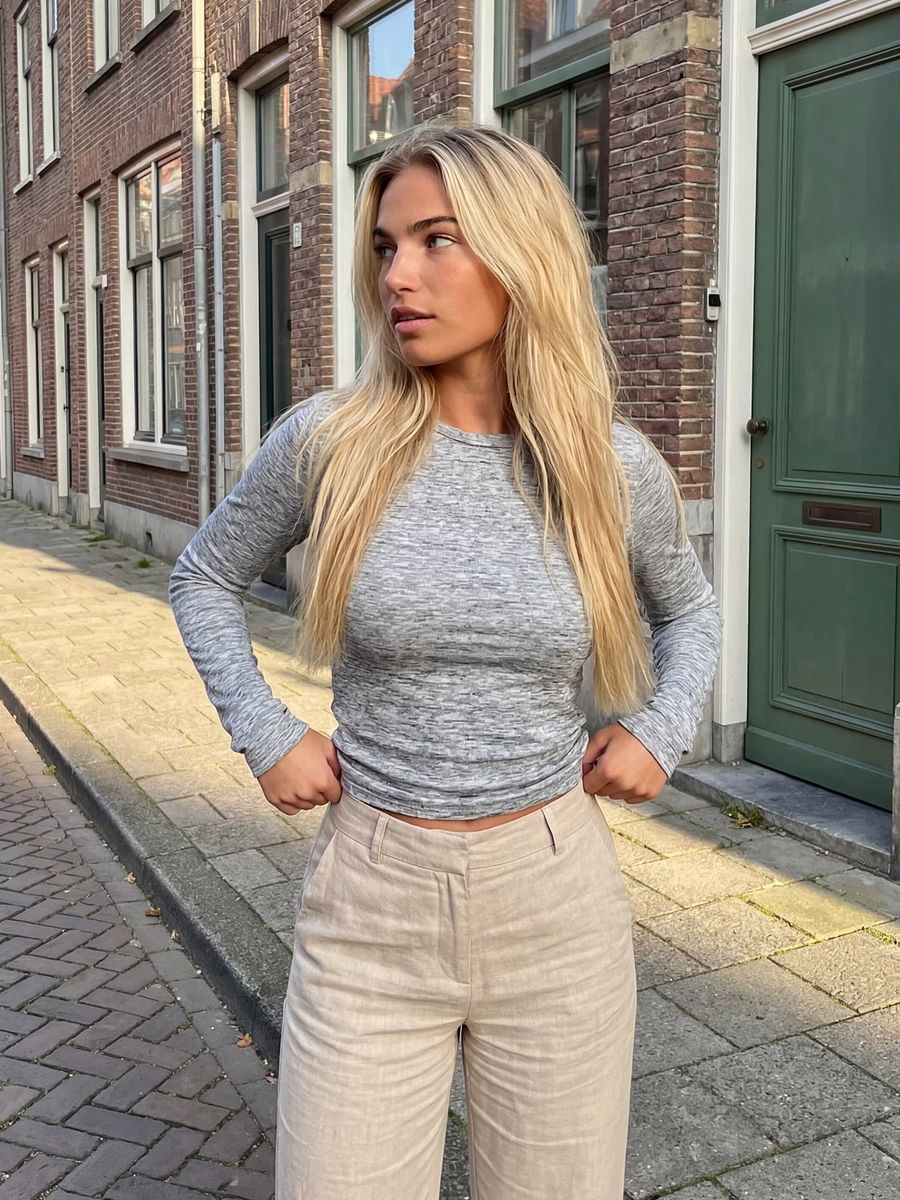
You steer a natural pose in an AI portrait by putting the weight on one leg and turning the body slightly, so the hips and shoulders tilt in opposite directions instead of standing bolt upright and symmetrical. That small difference decides whether your character reads as relaxed or like a passport photo. Below you'll learn how to put pose and body language into your prompt on purpose.
Why an AI portrait so often looks stiff and frontal
Without direction, a model falls back on a symmetrical, frontal pose: straight to camera, weight even across both legs, shoulders level and arms hanging limp at the sides. That is the statistical average of millions of portraits, and it looks lifeless as a result.
A real person almost never stands like that. We shift our weight, turn away a little and give our hands something to do. If you don't name those small things, the model won't do them either.
Contrapposto: the classic basis of a natural pose
Contrapposto, Italian for "counterpoise", is a stance where the figure carries its weight on one leg, so the hips and shoulders tilt in opposite directions: if one hip sits higher, the shoulder on that side drops. Sculptors have used the trick for millennia.
The Kritios Boy from around 480 BCE is considered the first known Greek statue to use contrapposto (source: Britannica, Wikipedia), and Polykleitos even built a theory of proportion around it with his Doryphoros. The effect is that the body takes on a slight S-curve and looks alive rather than frozen. You don't need to put the word "contrapposto" in your prompt, but you do need to describe what it does.
How to describe a pose in your prompt
Put the mechanics of the pose into concrete words, not jargon. A model responds better to "weight on the back leg, one hip slightly raised" than to a single abstract label.
- Weight on one leg, the other knee slightly bent and relaxed
- Hips and shoulders tilted in opposite directions (one hip higher, the opposite shoulder lower)
- Body turned slightly away from the camera, head returning toward the lens
- Give the hands a job: in a pocket, around a coffee cup, running through the hair
- Chin a touch forward and down, so the neck reads longer
Don't want to type this out every time? Let the prompt generator expand your short description into a full pose instruction.
The three-quarter angle, the gaze and the hands
A three-quarter angle, with the body roughly 30 to 45 degrees off the camera, almost always looks more natural and slimmer than dead-on. Let the far shoulder recede a little and bring the face toward the light.
Avoid arms that hang straight and slack at the sides: give them a slight bend or a task. And direct the gaze separately from the pose. A body that turns away while the eyes come back to the lens reads as engaged, whereas eyes looking off the same way the body turns feel more narrative or distant.
Keep the pose consistent across a series
If you want the same persona across several images, use an approved portrait as a reference in the photo generator and describe the same standing leg and turn direction every time. That keeps the body language recognisable while you change location, wardrobe and light. Variety in the surroundings keeps the series fresh; a fixed family of poses keeps it recognisable.
Frequently asked questions
What is contrapposto in short?
A stance where the weight rests on one leg, so the hips and shoulders tilt in opposite directions and the body takes on a slight S-curve. The word is Italian for "counterpoise".
Why does my AI character keep standing bolt upright to camera?
Because a symmetrical, frontal pose is the statistical average of portrait data. Without an explicit description of weight shift and a slight turn, the model defaults to it.
Do I always have to use a turned pose?
No. A strictly frontal, symmetrical pose can feel deliberately strong or formal. The trap is when it happens by accident, so choose your pose on purpose rather than leaving it to the model.
How do I keep the same pose across several images?
Use a reference photo and describe the same standing leg and turn direction each time. Do change the surroundings and light, so the series stays varied without the body language jumping around.
Ready to make your character look more natural? Create an account and test a few pose variations side by side.